Starting the year off right is SO important for any class, but especially in Algebra 1, in particular. That’s why I call our first unit The Foundations of Algebra.
Everything that is done in the first unit lays the foundation for everything to come throughout the rest of the year (and for the rest of their entire HS math career) so there is a lot riding on starting the year strong. No pressure, right?

There is also a delicate balance to strike between reviewing essential prerequisite material from past courses that students might not remember and getting bogged down waiting for students to have mastered all of their prior skills.
I’ll walk you through what topics you should include in the first unit of Algebra 1 (and why!) down below. Click here to jump there, or keep on scrolling.
Lay the right foundation for success!
As I hinted above, the first unit of Algebra 1 needs to be well thought out to cover essential vocabulary and skills that will carry with your students throughout the entire year, as well as throughout their future math courses. Before I go over all of the specifics of what you should include, I’m going to dive into why you should trust me – this random lady on the internet – and why you may want to deviate from what the first unit in your textbook covers.
Why Listen to Me (What’s this Lady Know)?
I’ve been (mis?)fortunate enough to have had a 6 or 7-year stretch where I was assigned a new prep every single year. As a result, I have taught every math class from 7th grade all the way through college credit precalculus and statistics.
While this was admittedly very challenging at the time, I am so grateful for the perspective it has given me as a math educator. I have been given a unique ability to really see where the seeds of a math concept get planted and how they grow and develop over time into college-level concepts.
I have seen honors students stumble over a question because they didn’t know what an “integer” was – a simple vocabulary word bringing them to a dead halt. Doing synthetic division to find the zeros of a cubic polynomial? No biggie! Identifying all integer solutions? Ah, that’s the hangup. Over the years, I’ve seen countless examples like this – each example making it clearer to me what needs to be emphasized from the start in Algebra 1. And these topics rarely were covered in what our textbook thought would be the ideal first unit of the year.
On the other hand, I’ve also had the pleasure of teaching an Algebra 1 Support math class for many years. This is a math class for students who were not successful in their middle school math courses, for whatever reason, as well as students with IEPs and 504s. I’ve worked hard at trying different things over the years, tweaking and adjusting until I found the right combination of topics for Unit 1 that really laid the best foundation for this group of students.
I found a collection and progression of topics to make the perfect Unit 1 that encompassed just enough review from their past math classes to give them a point of access into the year, touched on common mistakes and misconceptions that I’ve seen come back year after year to haunt students (even in those honors courses), and teaches them how to check their work so they can always know if their work is done – all while emphasizing vocabulary they will need for all future math courses.
After many years of tweaking and perfecting, I’ve developed a full year of Algebra 1 guided notes that are able to meet the needs of all learners, even those who have struggled with math or had challenges in the past. As a result, my Algebra Support classes consistently have had a 90%+ pass rate while still covering all grade-level content without watering down any standards. Much of that success I attribute to starting off the year right. Without further adieu, here’s what you should cover in your first Unit of Algebra 1 (and why).
Tips for Planning Your First Unit of the Year
If you’re new to teaching Algebra 1, figuring out what is essential to include in your unit notes can be overwhelming. In the section below, I’ll walk through every topic that you should include in this unit, and I’ll also provide direction about what to emphasize while covering that topic to ensure your students are being exposed to common mistakes & misconceptions and are able to develop a deep sense of conceptual understanding.
Use this list as a prescriptive guide for your planning.
At the bottom, I have included a YouTube video that shows every page of notes I give my students during this unit to give you a better sense of how I apply all of these planning tips to create a cohesive unit of guided notes for my students.
What to Include (and WHY)
In my Algebra 1 class, I call the first unit of the year the Foundations of Algebra. Here are the topics I include, and what I recommend emphasizing while teaching this unit and creating your guided notes.
Unit 1 – The Foundations of Algebra
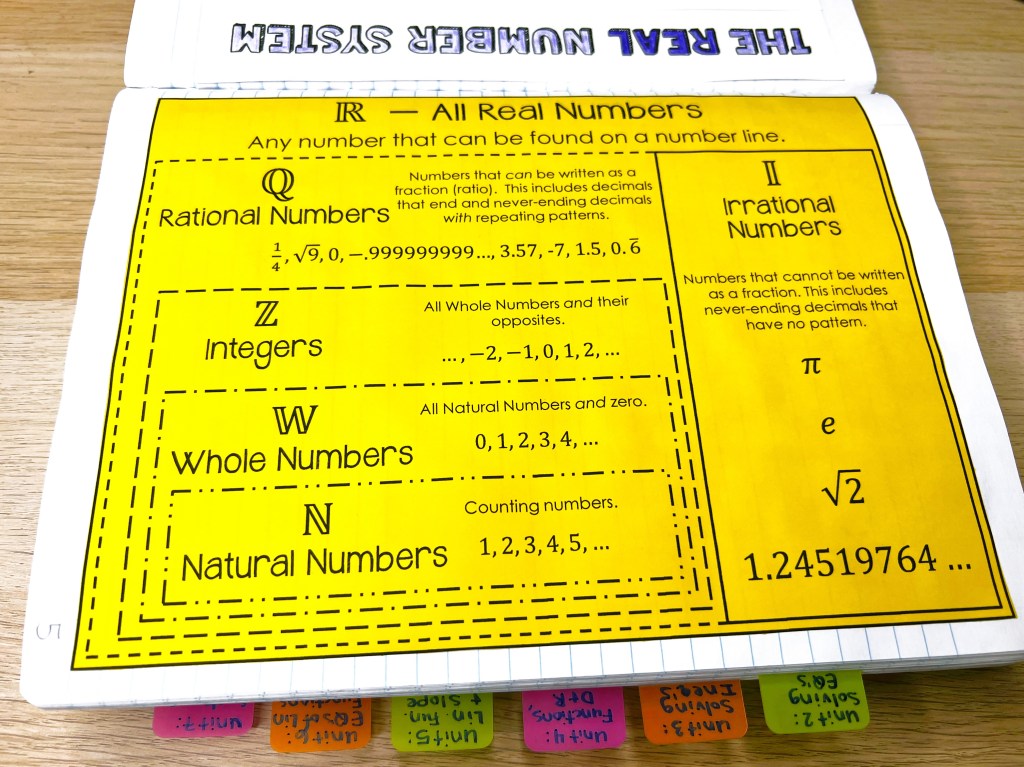
Topic 1.1 – The Real Number System
Cover essential vocabulary that students will see in all future math courses. Students need to know what an integer is or what a rational number is when they see a question asking about it.
Topic 1.2 – Properties of Real Numbers

Not only will these be used as valid ways students can manipulate expressions and equations throughout the year, but they will also be used heavily the next year when students take Geometry and do 2-column proofs.
Topic 1.3 – Order of Operations
Much of Algebra is evaluating functions, which requires students to have a good understanding of the order of operations. Without it, they may not realize an answer is unreasonable if they used a calculator and typed something incorrectly. I use the traditional PEMDAS and discuss how the P standards for parentheses and other grouping symbols, but I also include options with GEMDAS, GEMS, and BEDMAS to fit your teaching needs.
Topic 1.4 – Evaluating Algebraic Expressions
This prepares students for all of the evaluating functions they will be doing as well as for checking their answers after solving an equation.
Topic 1.5 – Combining Like Terms
This is an essential skill for simplifying expressions & solving equations. This is also a perfect opportunity to include perimeter applications.
Topic 1.6 – Distributive Property
This is another essential skill for simplifying expressions & solving equations and also prepares students for factoring down the road. Don’t forget to include examples that also require students to combine like terms (CLT) after using the distributive property. Area applications can be included as well as problems with fractions to help students start reviewing fraction operations. Don’t forget to practice problems of the form -(expression) or -(2x-5) where there is an implied negative 1 in front of the parentheses that needs to be distributed!
Topic 1.7 – Translating Expressions, Equations & Inequalities

Kick off this topic with an overview of all of the keywords they may run into. Make sure to emphasize keywords that are less intuitive for students and lead to mistakes. Include real-world examples to help them make sense of those phrases.
Examples:
- No more than – students will just register the “more than” portion and think they need at least that number.
Real-world example: If your mom says you can have no more than 3 friends over, would she be happy with 1 friend? 2? 3? 4? 5? Why? - No less than – similar misconceptions occur among students.
Real-world example: If your mom asked you to do the dishes no less than 3 times this week, would she be happy with 1 time? 2? 3? 4? 5? Why? You wanted to eat no less than 2 cupcakes this weekend. Would you be happy with 1 cupcake? 2? 3? 4? 5? Why? - Subtracted from – This is a keyword phrase to emphasize because students commonly will translate their expressions backward. If they read “a number is subtracted from 10,” you will see x – 10 on many students’ papers when they should have 10 – x. Helping them identify this as a turnaround phrase, a phrase where the order you read it is opposite to how you would write the algebraic expression, is crucial.
Real-world example: If I subtracted $10 from what I have in the bank, what expression could we use? We know I started with a mystery amount of money in the bank, or $x, and then we took $10 away, so we’d use x – 10. NOT 10 – x. - Less than (fewer than) – In a subtraction context, this can really throw students for a loop. If they read “5 less than a number” I can guarantee you a sizeable chunk of your class would incorrectly translate that to 5 – x. This is another turnaround phrase to emphasize to your students. You may even see a few confused thinking they should write the inequality 5 < x (the difference between 5 less than a number and 5 is less than a number is so subtle).
Real-world example: A student has 3 less hats than their brother. What’s an expression we could write to express this? The first and only thing we need to know is how many hats the brother has, and then we can get 3 less by subtracting. Since we don’t know how many hats he has, we could use x as a placeholder and then write x – 3 for the expression. We wouldn’t write 3 – x, because that would probably leave us with negative hats.
1.7b – Practice Translating Expressions, Equations & Inequalities
If you want students to have a strong foundation of Algebra skills, they need to be comfortable with a variety of mathematical vocabulary. This also makes it easier to do applications and interesting real-world math problems down the road.
Topic 1.8 – Solving 1- & 2-Step Equations
1.8a – Solutions to an Equation

Before you even start solving equations, make sure students understand what the definition of a solution is and what it means for a number to be a solution to an equation. Refer back to this definition every time you have students check their answers as well as when you introduce special case solutions, down the road.
1.8b – Solving 1-Step & 2-Step Equations
Emphasize problems that require the reciprocal to solve, and prioritize teaching students how to check their answers every time.
Although students may have learned how to solve 1- & 2-step equations in a prior course, it’s an essential revisit to make sure every student has the same foundation, built just the way you want it, to last them throughout the year.
Topic 1.9 – Solving 2-Step Inequalities
1.9a – Sign Flipping Investigation
Help students understand WHY they need to flip the inequality symbol after multiplying or dividing by a negative number on both sides of the inequality.
1.9b – Solving 2-Step Inequalities
Make sure to go over the difference between open & closed endpoints and how to graph an inequality as well as how to properly write their answer as a solution set
Looking for even more details?
Read this blog post and this blog post to get even more information about what to include in your first unit of Algebra 1.
See Every Page
If you want to take a look at every page I include in Unit 1 of my Algebra 1 interactive notebook, check out this video. You can speed it up or pause at any point to view a specific page.
Want it D-O-N-E for you?
Let me lighten your planning load!
If you’d like to grab the daily guided notes and recap warm-ups I have created for this unit, you can find the interactive notebook version here and the binder note version here.
All of the amazing planning tips from above have been incorporated to make an incredibly cohesive and thorough unit that will help your students reach grade-level standards.
This unit includes all of the notes you would need to teach your daily lessons, along with color-coded answer keys for every set of notes. There are also daily recap warm-ups included along with a pacing guide so you know just what to cover each day!
You can grab my entire year of interactive notes & warm-ups for Algebra 1 here. You can also get the exact same set of notes in a print-and-go binder format here.
 Math by the Mountain