Solving inequalities is a skill in Algebra 1 that is useful on its own, but it is much more powerful as a connecting unit. The solving multi-step inequalities unit both serves to re-emphasize everything that was learned throughout the solving multi-step equations unit and also sets students up to be successful and stress-free when learning how to identify the domain and range of functions in subsequent units.

Click here to jump to your list of tips on what to include in your unit of notes (and why), or keep on scrolling below.
Where to Sequence this Unit?
When I first started teaching Algebra 1, I was hired at a school that had just gone through a curriculum adoption the year prior and we were to use the district-provided pacing guide, which followed the adopted name-brand publisher’s textbook.
“Where did your unit on solving multi-step inequalities fall?” you may ask? It was our 6th unit of the year. SIXTH.
I was never satisfied with this placement, but it took years for me to really be able to articulate why and be able to advocate to fix it.
According to our provided pacing and that textbook, the first half of our year would look like:
Unit 1 – A review/prerequisites unit,
Unit 2 – Solving multi-step equations,
Unit 3 – Domain, Range and Functions,
Unit 4 – Linear (standard form and slope)
Unit 5 – Linear (slope-intercept form, and writing equations of lines)
Unit 6 – Solving multi-step inequalities
Unit 7 – Systems of Equations & Inequalities

One issue with the given sequencing of units was that inequalities and equations were months and months apart in the year (unit 2 vs. unit 6). With how much overlap there is between the two units it felt so disjointed, and so much momentum was being lost.
The bigger crime was the placement of this unit after teaching domain and range.
No matter if you have your students write domain and range in inequality, set, or interval notation, your students need to thoroughly understand inequalities, especially compound inequalities, to be successful in this often tricky (but oh so crucial) skill.
Domain and range come back, increasing in frequency as students take Algebra 2 or even pre-calc down the road, so setting your students up to be successful and laying a strong foundation of inequalities in Algebra 1 will pay huge dividends.
While there is still plenty of room for wiggle room with the order you sequence your units in Algebra 1, I strongly suggest that you teach solving equations before solving inequalities and that you teach solving inequalities before teaching domain & range.
Tips for Planning Your Solving Inequalities Unit
If you’re new to teaching Algebra 1, figuring out what is essential to include in your unit notes can be overwhelming. In the section below, I’ll walk through every topic that you should include in this unit, and I’ll also provide direction about what to emphasize while covering that topic to ensure your students are being exposed to common mistakes & misconceptions and are able to develop a deep sense of conceptual understanding.
Use this list as a prescriptive guide for your planning.
At the bottom, I have included a YouTube video that shows every page of notes I give my students during this unit to give you a better sense of how I apply all of these planning tips to create a cohesive unit of guided notes for my students.
What to Include (and WHY)
In my Algebra 1 class, solving multi-step equations is our second unit of the year. Here are the topics I include, and what I recommend emphasizing while teaching this unit and creating your guided notes.
Unit 3 – Solving Multi-Step Inequalities
Topic 3.1 – Inequality Symbols & Keywords
Introduce each inequality symbol, including compound and’s and or’s, and emphasize how they are graphed with open or closed endpoints. Also include some common keywords that signify each inequality symbol (for example, maximum, at most, no more than, not above, and up to all means <).
Make this an easy-to-reference page in your student’s notes because they will be looking back to it throughout the unit until they gain fluency in recognizing each of the symbols.
Topic 3.2 – Intro to Graphing & Writing Inequalities
Before your students are asked to solve and graph the solution set to inequalities, we need to slow down and just focus on the component of graphing inequalities to ensure students will be able to do that.
Cover examples of graphing inequalities where the variable is on both the left and right side of the inequality.
Examples:
- x > 4
- -3 < x
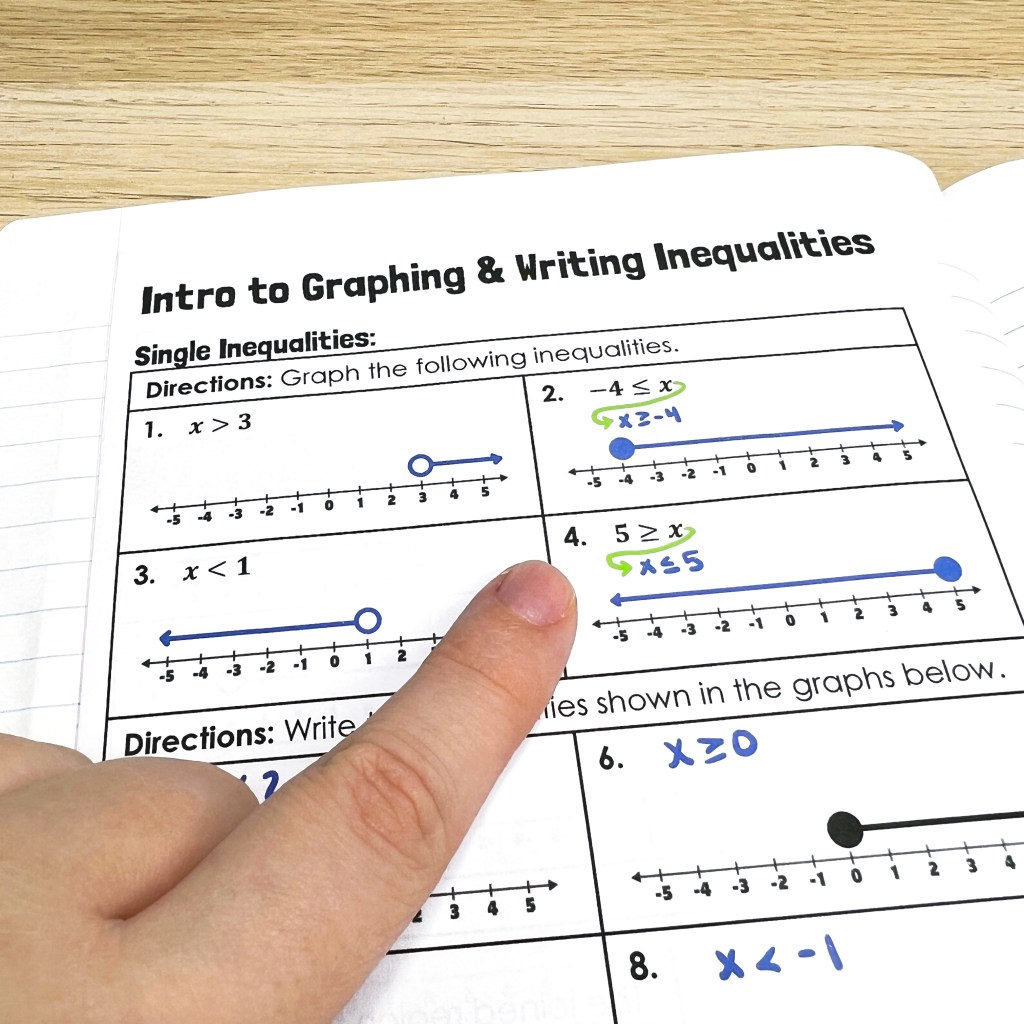
Students are much more likely to make mistakes with inequalities that are set up “backward” like the second example. Make sure to emphasize to students how they can flip an inequality so the variable comes first.
Remind them that every inequality comparison can be phrased in two ways. For example, I normally pick a kid in my class who is taller than me to give the class the following example: We could say “You are taller than me,” but we could also say “I am shorter than you.” This helps students students understand that when we flip what goes first, we also change the comparison word (or symbol).
Make sure to also include examples where students can practice graphing compound inequalities.
In addition to the graphing practice, include examples where students are asked to write the inequality that is being shown from a graph or in a written scenario. This helps students think deeper about their understanding of inequalities and helps them develop a stronger conceptual understanding of what the symbols mean.
Topic 3.3 – Solving Multi-Step Inequalities
This topic should come together very naturally for your students.
Remind them of past learning you have done:
- In Unit 1, they learned how to solve and graph 2-step inequalities and also did a sign-flipping investigation to discover that the inequality symbol must flip directions if they multiply or divide by a negative number to both sides of the inequality while solving.
- In the last topic, they focused a lot on graphing the solution sets.
- In the last unit, they learned how to solve multi-step equations.
Let your students know that there is nothing at all new about what they will be learning in this topic, they are just combining past skills.
Students will approach each problem exactly the same way they have learned to approach solving multi-step equations in their last unit, with the exception of needing to keep an eye out for any sign-flipping moves. Once their inequality has been solved, they’ll graph it on a number line, which is exactly what they have been practicing in their last topic.
Nothing new – just skill stacking.
Topic 3.4 – Multi-Step Inequalities Applications
Real-life problems are so rarely going to be an equation where something must precisely equal something else.
In reality, inequalities are much more relevant to many real-world scenarios that involve constraints.
This doesn’t need to be a long topic, but you should cover a few real-world examples where students must write and solve an inequality to answer a question. Make sure your students are defining their variables and interpreting what their solutions mean.
Topic 3.5 – Intro to Compound Inequalities – Solving, Graphing & Writing
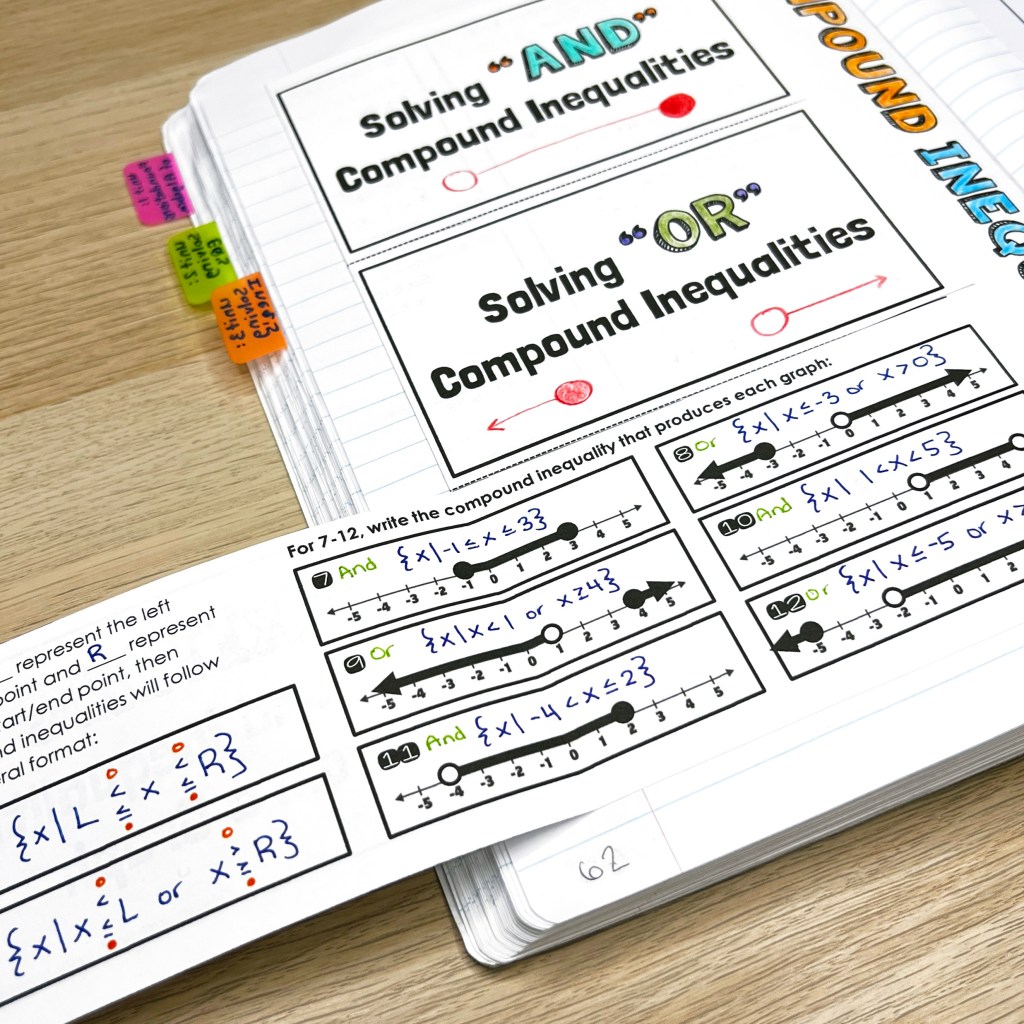
Compound inequalities can be tricky for students. Start by focusing on And and Or inequalities separately.
For And’s, make sure to include at least one example written each way:
- -3y>-15 and y+7>10 (with the word “and” included)
- -2<2(x+1)<12 (without the word “and” included)
As always, have students graph their solution set once they are done solving and write their answers as a solution set (or in interval notation, if that’s what you have your students do).
Writing compound inequalities in set notation (or interval notation) can be really tricky for students, so I also suggest including a section where you have a bunch of compound inequalities graphed (and’s and or’s mixed together) and students are asked to write the inequality that is being shown.
Practicing this in isolation can be very helpful for students to gain confidence in how they need to format their answers, as well as determining if an inequality is an and or an or.
Topic 3.6 – Solving Compound Inequalities
Since solving and graphing compound inequalities can be notoriously tricky for students (and are at the heart of understanding how to do domain and range down the road), it’s worth taking a second day to really develop your students’ understanding of this topic.

In addition to giving your students more practice with solving and graphing and’s and or’s, make sure to cover special cases where there is no solution or infinite solutions (or even when a compound inequality really is just a single inequality in disguise).
Topic 3.7 – Solving Absolute Value Inequalities
Solving absolute value inequalities is the perfect way to connect back to solving absolute value equations, as well as to give your students even more practice with solving compound inequalities.
Topic 3.7a – Intro to Absolute Value Inequalities
Refresh students’ memories about solving absolute value equations and use this to let students discover that |x|<# turns into and compound inequalities and |x|># turns into or compound inequalities.
Help students make the connection that every absolute value inequality is really just a compound inequality in disguise.
Topic 3.7b – Solving Absolute Value Inequalities
Since this is definitely a trickier topic for students, give them a ton of practice. Include plenty of examples where students must isolate the absolute value before continuing to solve, and then also include a couple of examples with special case solutions (with no solution or infinite solutions).
See Every Page of Notes
If you want to take a look at every page of notes I include in Unit 3 of my Algebra 1 interactive notebook, check out this video. You can speed it up or pause at any point to view a specific page.
Want it D-O-N-E for you?
Let me lighten your planning load!
If you’d like to grab the daily guided notes and recap warm-ups I have created for this unit, you can find the interactive notebook version here and the binder note version here.
All of the amazing planning tips from above have been incorporated to make an incredibly cohesive and thorough unit that will help your students reach grade-level standards.
This unit includes all of the notes you would need to teach your daily lessons, along with color-coded answer keys for every set of notes. There are also daily recap warm-ups included along with a pacing guide so you know just what to cover each day!
You can grab my entire year of interactive notes & warm-ups for Algebra 1 here. You can also get the exact same set of notes in a print-and-go binder format here.
 Math by the Mountain
One thought on “Unit 3 Planning Guide: Teaching Solving Multi-Step Inequalities in Algebra 1”