You know that moment when a guest teacher actually takes the time to leave a compliment in the sub notes? It’s the dream. This year, all four of my guest teachers have specifically called out how smooth and easy attendance was in my room, and it’s all thanks to the cell hotel system.
Yep. My cell phone routine doubles as my attendance system, and it’s been an absolute game-changer. Here’s exactly how I make it work, and why I’ll be sticking with it.
What Is a Cell Hotel?
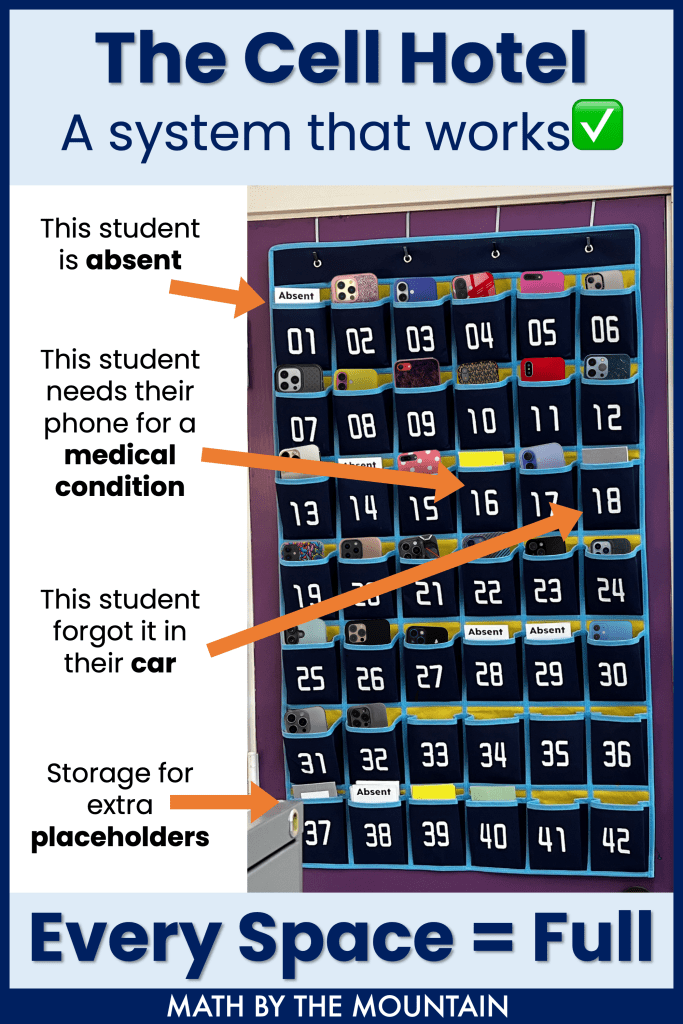
If you’re unfamiliar, a “cell hotel” is basically one of those hanging pocket charts (think shoe organizer) that students place their phones in at the start of class. Each student has a numbered pocket (matched to their seat number), and it becomes part of our daily entry routine.
It’s not a brand-new idea, but the way I use it for both phone management and attendance might be new to you.
I Was Really Hesitant to Try This
Let me be super honest: I was very hesitant to try the cell hotel. The idea of hanging what could easily be $40,000 worth of phones on my classroom wall made me seriously anxious. It felt like I was just inviting disaster.
What helped me move past the hesitation was a mix of structure, student buy-in, and location, location, location. I placed the cell hotel in a spot that is totally out of the way during class — no one has any business being near it, so if someone’s hanging out there, it’s immediately noticeable and easy to address. Once that was in place, I finally felt confident enough to go all in.
Why a Cell Hotel?
Before I ever asked students to hand over their phones, I made sure they understood why we were doing this. I explain at the start of the year that it’s not about control — it’s about focus and doing what is best for their ability to learn.
Even if students aren’t actively using their phone, just feeling a vibration in their pocket is enough to pull their mind away from what we’re doing. And that adds up. We’re working on math — we need every bit of brainpower we can get. When students understand that this system is for their benefit, not a punishment, they’re much more willing to engage.
And I also make space for humanity: I tell students from day one that if they have something going on, like waiting on an important message or needing to have their phone on them that day, they can just let me know. If a student asks to check something during class, I almost always say yes. The key is just keeping open communication.
How It Works (and Doubles as Attendance) – This is where the magic is!
As students walk in, they place their phones into the numbered pocket that matches their desk number. While they settle in, I scan the cell hotel and double-check with the seating chart and insert laminated “Absent” cards into any empty spots. That visual cue often reminds students who forgot, and they hop up and fix it without me needing to say a word.
If a student genuinely forgot or had something going on, I just check in quietly after I’ve finished taking attendance. It’s not a big deal, it’s almost always just a slip of the mind and is handled with zero conflict.
I keep all of the “absent” cards in pouch 38 so they’re easy to grab and return.
🤔 What If a Student Can’t Participate?
Here’s how I build in flexibility while keeping the system consistent:
- 📱 No phone at all? Some students don’t have one (confirmed by a parent). They use a laminated place-holder card with their name on it (stored in pouches 38 & 39, by A-day and B-day students).
- 🏥 Medical exception? If a student needs to keep their phone on them for a health-related reason, they also use a laminated place-holder card with their name on it.
- 🚗 Forgot it or need it for a one-time reason? That’s what the gray cards (in pouch 37) are for, temporary placeholders when needed.
- 🤝 Uncomfortable with the system? I had one student this year who was vocally uncomfortable with putting their phone in the cell hotel. We had a 1-on-1 conversation and made an agreement: they would keep their phone in their locker, and as long as I never saw it in class, it would never be an issue. If it ever did become a distraction, they’d use the cell hotel moving forward. I created a placeholder card for that student, and they still “check in” every day just like everyone else, staying fully accountable to the system…just in a way that works for them.
The placeholders are honestly what make the whole thing work. That’s the real difference-maker. Every pocket is full, every single day. There’s nowhere to hide. Without the placeholders, even if a few students have legitimate reasons for not using the cell hotel, it opens the door for others to assume I won’t notice when they skip it for not-so-legitimate ones, and honestly, they wouldn’t be wrong.
Because every pouch is filled, it’s incredibly obvious if something’s off. And, yes, sometimes students get a little creative. They’ll try slipping in an empty phone case or a super old phone they dug out of a drawer. But honestly? It’s pretty limited and very easy to catch. Those students are always the ones mysteriously on their phones during the first few minutes of class, or the pocket just looks… off.
I check the cell hotel every day, and if anything looks suspicious, I’ll just touch the pocket. If it’s a hollow case or a fake-out, I’ll know in a second. It’s a simple routine that keeps the system tight without adding extra work.
I also try to keep things light. If I spot an empty case, I’ll just call out, “Hey, So-and-So, did you forget something?” and usually get a sheepish grin, a quick apology, and the real phone in its spot within 30 seconds.
The Results: Why I’ll Keep Using It
Here’s the real reason I’m not giving this system up anytime soon:
- ✅ It actually keeps students off their phones. It’s not a cute suggestion — it’s a routine that works.
- ✅ It’s simple to maintain. Once it’s up and running, the system manages itself.
- ✅ It supports a focused, productive classroom. I spend less time redirecting, and students are more present.
That’s the goal. That’s why it matters.
Want to Try It?
If you’re considering trying a cell hotel in your own classroom, I’ve linked my editable card template here so you can customize it for your setup.
It took maybe 15 minutes to get it laminated and rolling — and I’ve saved hours of classroom time (and sanity) because of it. It’s a rare system that’s both low-effort and high-impact. This one is.
Let me know if you give it a try — I’d love to hear how it works for you!
– Audrey
Bonus: My Classroom Phone Policy (From My Syllabus)
Here’s the exact language I use to explain the policy up front. You’re welcome to borrow or adapt it if it helps:
📵 ELECTRONICS POLICY
Students are expected to be respectful of instructional time and wait to check messages or handle personal business (including work for other classes, family texts, or job coordination) outside of class time — before school, after school, or between periods.
Phones
Our class, like many others this year, uses a Cell Hotel system.
- Phones must be placed in the Cell Hotel at the start of class.
- Use the numbered pocket that matches your desk number.
- If you don’t bring a phone to school, your parent/guardian must send me a note or email.
- Phones are picked up at the end of class after I’ve made sure they’re all accounted for.
- This is a safety step — the teacher and school assume no responsibility for lost/stolen phones.
- If you’re uncomfortable placing your phone in the Cell Hotel, leave it at home.
- Phones may not be kept in backpacks or purses — the temptation to check is too high.
- If a student is caught with a phone during class, I’ll hold it until the end of the day and send an email home.
Need to contact your student during class?
Parents/guardians should call the main office at (XXX)-XXX-XXXX.
My electronics policy continues about computer usage as well as headphones/earbuds, but this is the section relevant to the cell hotel.
 Math by the Mountain
This is great policy with true clarification to both students and parents. I used a similar “Cell Phone Hotel” but I didn’t assign numbers, and I was not clear about my expectations and consequences if not followed through. Thank you for sharing your method and communication with us. I am going to try this system out this school year and hopefully I receive similar results as you have!
Thanks for sharing!!!!
Karlene Cicco
PA High School Math Teacher
LikeLike
What are the green cards for?
LikeLike
I have some students on A-Days (green) and others on B-Days (yellow) that just don’t have cell phones, so I have premade place holders with their names on it for both days. Green is my set of cards for my A-day students that do not have phones.
LikeLike