The Cell Hotel – A Cell Phone Management System that Actually Works

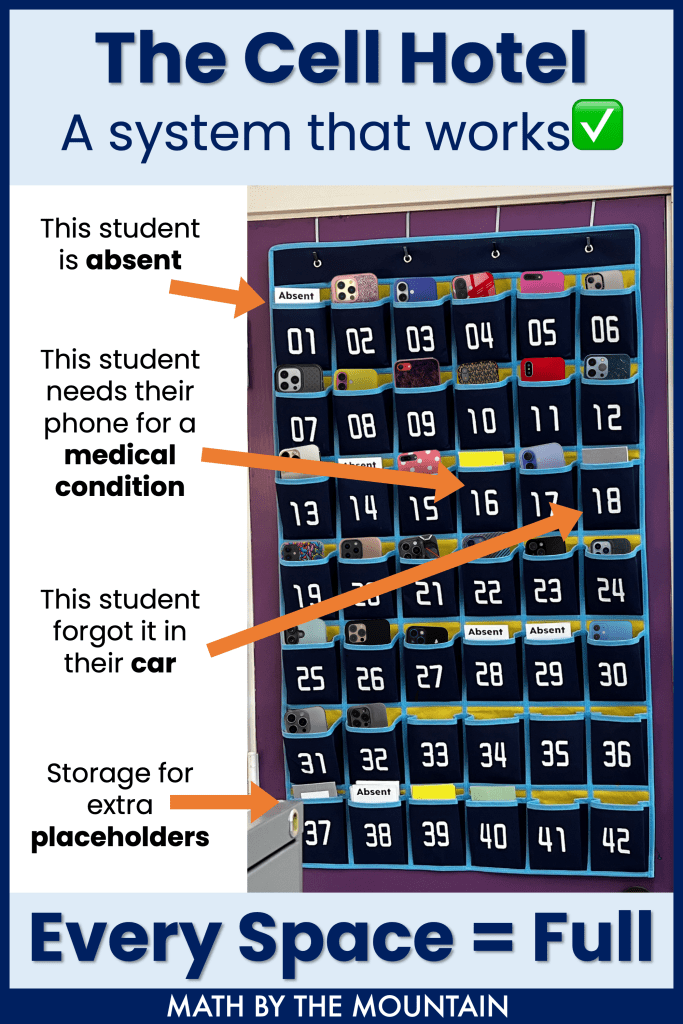
You know that moment when a guest teacher actually takes the time to leave a compliment in the sub notes? It’s the dream. This year, all four of my guest teachers have specifically called out how smooth and easy attendance was in my room, and it’s all thanks to the cell hotel system.

Yep. My cell phone routine doubles as my attendance system, and it’s been an absolute game-changer. Here’s exactly how I make it work, and why I’ll be sticking with it.


What Is a Cell Hotel?

If you’re unfamiliar, a “cell hotel” is basically one of those hanging pocket charts (think shoe organizer) that students place their phones in at the start of class. Each student has a numbered pocket (matched to their seat number), and it becomes part of our daily entry routine.

It’s not a brand-new idea, but the way I use it for both phone management and attendance might be new to you.

Continue reading

AP Statistics Exam Review – Inference Calculator Functions Stations Activity (AP Stats Exam Prep Activity)

Leading up to the AP Exam, the number one thing I hear from my students is that they want more calculator review practice.

And, you know what? That makes a lot of sense. Knowing how to efficiently use the TI-84 calculator‘s built-in inference functions can save them a lot of valuable time during the AP Exam, in both the multiple-choice and free response sections.

Unfortunately, those features only save time if students remember the correct function to use (7: ZInterval vs A: 1-PropZInt is a common confusion-causing offender) AND where to find that function.

While so many incredible review activities for preparing for the AP Exam already exist, I couldn’t find exactly what my students wanted for calculator review, so I created this high-impact stations activity!

  • Each station includes a scenario that either asks the student to construct and interpret a confidence interval or to perform a significance test to assess a claim.
  • Every station includes the stipulation that they can assume all conditions for inference have been met, that way students can just focus on quickly and efficiently using their calculator to get an answer.

In addition, there is a cheat sheet with all of the calculator functions listed out for each procedure type, along with tips about how to use the functions or what additional information to include in addition to their calculator output (like degrees of freedom).

One of my favorite features about the calculator functions cheat sheet is that it is very transparent about when using the calculator functions is actually NOT the most time-efficient approach (like when performing inference calculations for slope, since computer output will be given).

There are 15 stations, covering:

Finding a confidence interval for…

  • a single proportion
  • a difference in proportions
  • a single mean
  • a difference in means
  • a mean difference
  • slope

Performing significance tests for…

  • a single proportion
  • a difference in proportions
  • a single mean
  • a difference in means
  • a mean difference
  • Chi-square GOF
  • Chi-Square test for homogeneity
  • Chi-square test for independence
  • slope

“This is a must-do exam prep activity for my students!

Free Mini-Version!

Try before you buy! This free sample includes 4 of the 15 stations.

Free Sample:
Includes 4 stations covering inference for:
✅ Proportions
❌ Means
❌ Chi-Square
❌ Slope

vs.

Paid Activity:
Includes 15 stations covering inference for:
✅ Proportions
✅ Means
✅ Chi-Square
✅ Slope

Click here to get the FULL ACTIVITY with all 15 stations.

Happy reviewing with your students!
Unit 4 Planning Guide: Teaching Functions, Relations, & Domain and Range in Algebra 1

Being asked to identify the domain and range of a function can often make even older and more experienced Algebra students fumble, but we’re in luck! We were so intentional in choosing the content that was included in our first three units of the year, that this unit will come together with a little smattering of everything that came before.

The functions, relations, domain & range unit will feel like the natural next step continuing off what your students have already learned, allowing for a fumble-free, stress-free unit.

Continue reading

Unit 3 Planning Guide: Teaching Solving Multi-Step Inequalities in Algebra 1

Solving inequalities is a skill in Algebra 1 that is useful on its own, but it is much more powerful as a connecting unit. The solving multi-step inequalities unit both serves to re-emphasize everything that was learned throughout the solving multi-step equations unit and also sets students up to be successful and stress-free when learning how to identify the domain and range of functions in subsequent units.

Continue reading

Unit 2 Planning Guide: Teaching Solving Multi-Step Equations in Algebra 1

Solving equations is an essential Algebra 1 skill that comes back in so many ways throughout the year, from rearranging equations to slope-intercept form before graphing a line, to solving systems of equations and even solving quadratic equations.

Solving multi-step equations is at the heart of what we ask Algebra 1 students to do – it is certainly a Top 5 unit if we were ranking them all by importance.

Continue reading

Everything You Need to Know: Using Interactive Notebooks with AVID

So you just found out you are working at an AVID school and are trying to figure out how to incorporate all the things into your lessons.

Lucky for you, interactive notebooks (INBs) or interactive student notebooks (ISNs) and AVID are a perfect match — but that doesn’t mean it isn’t overwhelming learning how to get started.
PS: There’s no difference between INBs and ISNs, it’s more of a tomayto/tomahto situation.

If you’re new to AVID, here’s a quick rundown:

Continue reading

How to Save Time with Interactive Notebooks in Algebra 1

“I’m wanting to do interactive notebooks, but how do you make it not take so long?”

This is, by far, the #1 question I get from other math teachers.

Continue reading

How to use Interactive Notebooks as Study Tools in Algebra 1

Interactive notebooks are study tools at their core. There are many ways to encourage students to develop this relationship with their notebook. Here are a few:

Continue reading

How to Grade Interactive Notebooks in Algebra 1

“How do you grade interactive notebooks” is a common question I get.

And, to be honest, I don’t.

Not always anyways!

To Grade or Not to Grade?

Continue reading